What is the role of Edge Cloud in 2026?
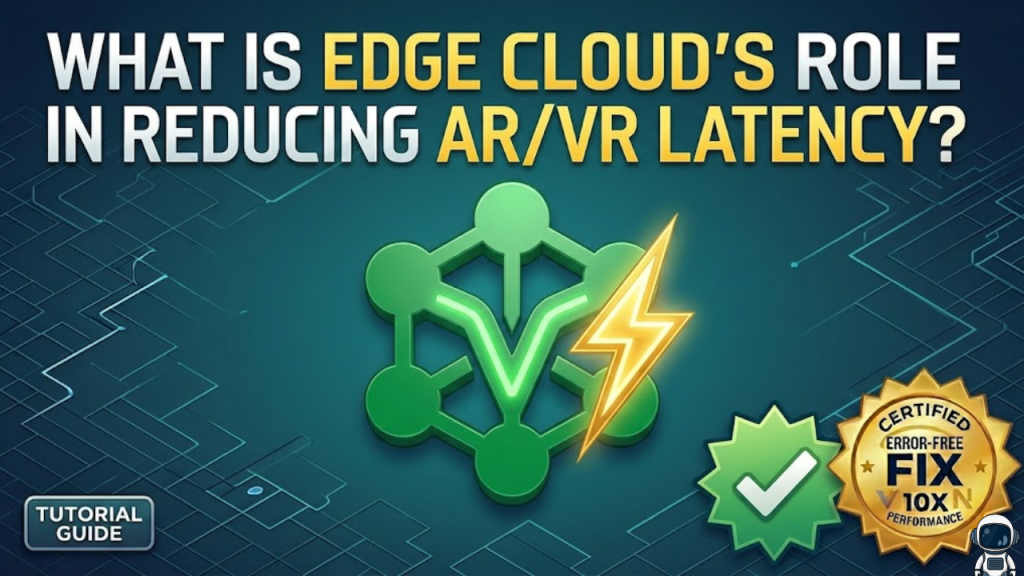
Edge Cloud refers to the distribution of computing resources to the “edge” of the network, significantly closer to the user than traditional centralized data centers. In 2026, its primary role is to eliminate the “Motion-to-Photon” lag that causes motion sickness in AR/VR users. By processing data at local edge nodes (often within 200 kilometers of the device), Edge Cloud reduces round-trip latency from 50-200ms in the cloud down to a staggering 1-10ms.
This shift allows headsets to remain lightweight and wireless while still delivering high-fidelity, real-time graphics that were previously only possible with a tethered PC.
Why AR/VR Specifically Requires the Edge?
Immersive applications are uniquely sensitive to delay. Even a minor lag can break “Presence” or cause physical discomfort.
| Metric | Centralized Cloud | Edge Cloud (2026) | AR/VR Impact |
| Round-Trip Latency | 50ms – 200ms | 1ms – 10ms | Eliminates nausea & lag |
| Bandwidth Load | High (Clogs core network) | Low (Local processing) | Smoother 8K streaming |
| Processing Site | Remote Data Center | Local Tower / Hub | “Untethered” freedom |
| Data Security | High Transit Risk | On-site / Local | Improved privacy |
| Reliability | Network Dependent | Resilient / Local | Stable in-field AR |
3 Ways Edge Cloud Powers 2026 Immersive Apps
In 2026, the convergence of 5G mmWave and Edge AI has enabled three critical “Spatial Features”.
1. Split Rendering
Headsets in 2026 are often under 40 grams. To achieve this, they use Split Rendering: the device handles simple tracking and “reprojection,” while the Edge Cloud renders the heavy, photorealistic environment and “streams” it back to the glasses. This allows for AAA-quality graphics on devices as light as standard sunglasses.
2. Contextual Spatial Awareness
AR glasses need to “understand” the world in real-time. Edge Cloud processes 120-billion-parameter language models and local image generation to overlay helpful data, like identifying a broken part in a factory, instantly. If this were sent to a distant cloud, the overlay would “drift” and fail to track the object correctly.
3. Multi-User Synchronization
For “Social VR” and the “Industrial Metaverse,” everyone in a virtual space must see the same thing at the same time. Edge Cloud acts as a local “Anchor,” syncing movements for all users in a specific building or city block with sub-millisecond precision, preventing the “ghosting” effect common in older systems.
Frequently Asked Questions (FAQ)
1. Is Edge Cloud better than on-device processing?
It depends on the task. In 2026, we use Hybrid AI: simple gestures are processed on-device to save power, while complex 3D rendering and deep-data analysis are pushed to the Edge Cloud to save the device’s battery and prevent overheating.
2. Does 5G enable Edge Cloud?
Yes. 5G (specifically mmWave) is the “highway” that carries data to the edge node. Without the high-speed, low-interference path provided by 5G, the latency benefits of the Edge Cloud would be lost in the “last mile” of the connection.
3. Will Edge Cloud make VR headsets cheaper?
Yes. By offloading the expensive, power-hungry GPUs to the network, manufacturers can build headsets with simpler hardware, making high-end VR accessible to the mass market in 2026.
4. Why do I see an Apple Security Warning on my AR glasses?
If your AR application attempts to stream your camera’s surroundings to an unverified or non-encrypted Edge node, you may trigger an Apple Security Warning on your iPhone or Vision Pro.
5. What is “Multi-access Edge Computing” (MEC)?
MEC is the 2026 standard for Edge Cloud. It allows cloud service providers to host their servers directly inside the cellular network’s towers, cutting the physical distance data must travel to a minimum.
6. Can I use Edge Cloud for remote work?
Absolutely. In 2026, virtual offices and 3D meeting spaces use Edge Cloud to ensure that “Eye Contact” and “Hand Gestures” are perfectly synced, making remote collaboration feel as natural as being in the same room.
7. Does the Industrial Metaverse require Edge Cloud?
Yes. 75% of industrial VR implementations in 2026 report a 10% increase in efficiency because Edge Cloud allows for real-time digital twins of entire factories with zero lag.
8. What is the “Motion-to-Photon” limit?
The human eye begins to notice lag if the delay between your movement and the screen’s update is more than 20 milliseconds. Edge Cloud is the only technology that can reliably stay under this limit for high-fidelity 2026 content.
Final Verdict: The Immersive Backbone
In 2026, Edge Cloud is the invisible force making the “Smartphone Replacement” possible. By moving the “brain” of the application closer to the user’s eyes, we have unlocked a world of untethered, photorealistic, and lag-free spatial computing.
Ready to build for the Edge? Explore our guide on Edge Functions vs. Serverless to see where your code should live, or learn about the Top Dev Skills Needed to Shine in 2026.
Authority Resources
- Firecell: Edge Computing vs Cloud – Latency Impact – Technical breakdown of 1–10ms latency metrics.
- floLIVE: Edge Computing in 2026 – Use Cases and Tech – Exploring the shift toward real-time analytics and IoT.
- Shayaike Hassan: The AR/VR Industry in 2026 – Market trends and the “Android moment” for spatial computing.
- Zero Latency VR: Predictions for 2026 Immersion – Expert insights on untethered hardware and low-latency graphics.