What is Cloud Sovereignty in 2026?
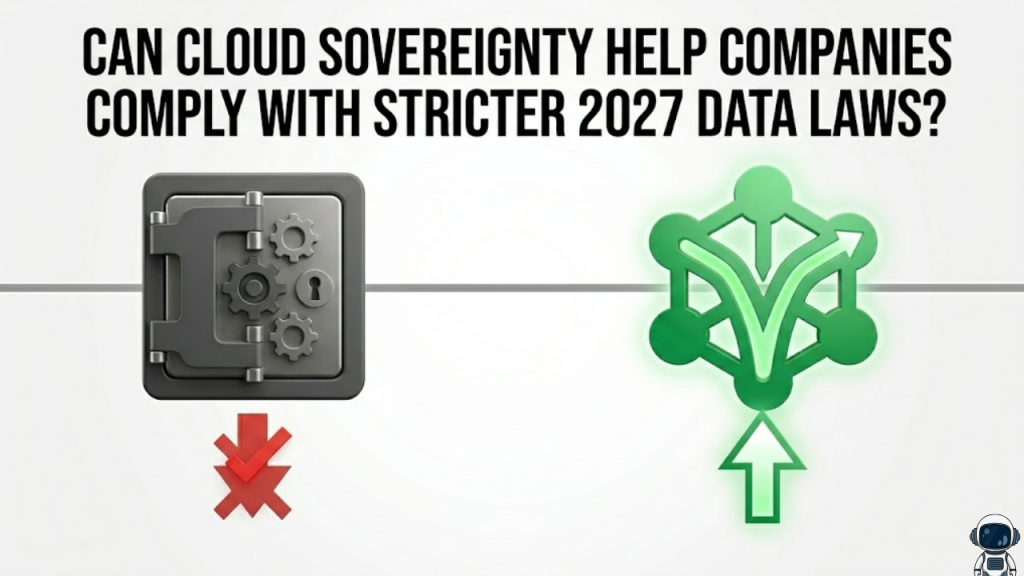
Cloud sovereignty is a digital architecture where data, operations, and technology choices remain under the jurisdictional control of a specific region (such as the EU). Unlike standard cloud hosting, which merely focuses on “Data Residency” (where the servers are), a sovereign cloud ensures that no foreign authority, including the US government under the CLOUD Act, can legally access or decrypt that data without local judicial approval.
In 2026, cloud sovereignty has evolved from a niche preference to a mandatory strategy for companies preparing for the January 2027 enforcement of global data acts.
The 2027 Regulatory Cliff: What is Changing?
By January 12, 2027, several major international laws will reach full enforcement, creating a “Compliance Cliff” for companies using traditional hyperscalers.
| Regulation | 2027 Requirement | The Sovereignty Solution |
| EU Data Act | Zero Egress Fees & Vendor Portability | Open stacks that prevent “hyperscaler lock-in” |
| NIS2 Directive | Auditable local operational control | Sovereign Ops (Local admin access only) |
| DORA (Finance) | Resilient multi-cloud exit strategies | Hybrid models that distribute risk |
| AI Sovereignty | Contextual data must match local laws | Region-Specific AI factory models |
3 Ways Cloud Sovereignty Solves the 2027 Problem
To stay compliant in 2027, your architecture must provide more than just encryption. It must provide Jurisdictional Autonomy.
1. Protection Against Extra-Territorial Access
Under the US CLOUD Act, American providers must turn over data even if it is stored in Europe. A sovereign cloud provider headquartered in the EU (like Exoscale or OVHcloud) operates outside this reach. Consequently, they provide a “Legal Moat” that protects your sensitive business data from foreign surveillance.
2. Elimination of Vendor Lock-In
The 2027 EU Data Act mandates that switching cloud providers must be free of charge (no egress fees). Sovereign clouds use open standards (like Gaia-X or OpenSource stacks) that make moving your data and workloads “frictionless.” This ensures you can exit a provider the moment they fall out of compliance.
3. Localized AI Factories
In 2026, Gartner predicts that 35% of countries will use region-specific AI platforms. By using a sovereign cloud, you can train AI models on local data that never leaves your jurisdiction. This allows you to comply with cultural, linguistic, and legal requirements that global “black box” models often ignore.
Frequently Asked Questions (FAQ)
1. Is sovereign cloud more expensive than AWS or Azure?
Initially, yes. However, by January 2027, the elimination of egress fees and the reduction in “compliance fines” (which can hit 4% of global revenue under GDPR) make sovereign clouds a more cost-effective long-term choice for regulated industries.
2. What is “Operational Sovereignty”?
It is the guarantee that only citizens of your region, who are subject to your local laws, have “Super Admin” access to the infrastructure. This prevents “Insider Threats” from foreign administrators.
3. Can I use a hybrid model (hyperscaler + sovereign)?
Absolutely. Many 2026 enterprises use AWS/Azure for non-sensitive public data and a Sovereign Cloud for core customer data and proprietary AI models. This “Multi-Cloud” approach is the best way to balance innovation with compliance.
4. Why do I see an Apple Security Warning on my sovereign app?
If your sovereign cloud uses custom encryption certificates that haven’t been cross-signed by a global Root Authority, you may trigger an Apple Security Warning on your iPhone. Always ensure your local SSL chains are properly established.
5. What is the “Gaia-X” project?
Gaia-X is a European initiative to create a unified ecosystem of interoperable and sovereign cloud providers. In 2026, it serves as the “Label of Trust” for companies looking for 2027-compliant infrastructure.
6. Does sovereign cloud affect my site’s speed?
No. In fact, sovereign providers are often closer to your users, which can reduce latency and improve your Interaction to Next Paint (INP) scores compared to distant hyperscaler regions.
7. What is “Egress Fee Elimination”?
By January 12, 2027, cloud providers are prohibited from charging you to “take your data with you.” This is a major win for SMEs who previously felt “trapped” by the high cost of moving data between clouds.
8. How do I start a sovereignty audit?
Identify your “Sensitive Workloads” (customer IDs, financial records, AI data). Map their current jurisdictional paths and check if your provider is headquartered in a country with conflicting data laws (like the US CLOUD Act).
Final Verdict: Sovereignty is Survival
In 2026, Cloud Sovereignty is no longer a political ideal; it is a tactical necessity. By moving your critical data into sovereign environments today, you avoid the 2027 “Compliance Panic” and ensure your business remains resilient in an increasingly fragmented digital world.
Ready to secure your data? Explore our guide on Zero-Trust Architecture for Web Developers or learn about modern authentication in Why Passkeys are Replacing Passwords in 2026
Authority Resources
- Exoscale: Sovereign Cloud and Data Sovereignty Overview – A deep dive into jurisdictional and technological sovereignty.
- PwC: Cloud Sovereignty Without Compromise – Strategic advice for organizations balancing innovation with regional control.
- European Commission: The Data Act Explained – Official documentation on the 2027 egress fee ban and switching rights.
- Gartner: Predictions for AI Sovereignty 2027 – How geopolitical and regulatory pressures are reshaping the AI stack.