What is AI-assisted cloud management in 2026?
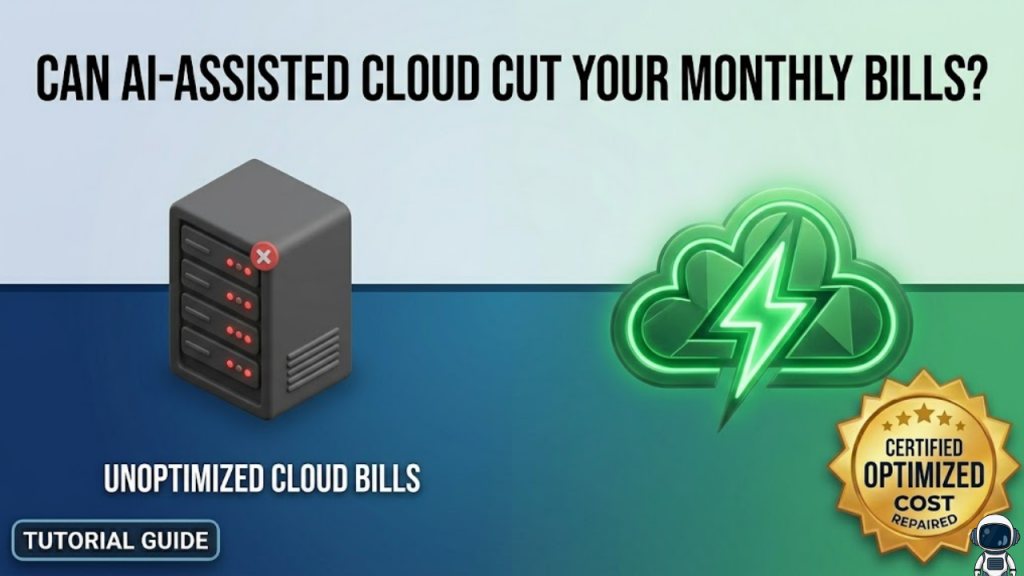
AI-assisted cloud management is a proactive approach that uses machine learning to monitor, forecast, and automatically adjust cloud resources. In 2026, it has moved beyond simple “cost dashboards” to Autonomous FinOps. These AI agents analyze millions of data points, including CPU, memory, and network traffic, to make real-time decisions that eliminate waste and optimize spending without requiring human intervention.
By shifting from reactive cost-cutting to predictive orchestration, AI ensures that you only pay for the exact amount of capacity you need at any given second.
4 Ways AI Slashes Your Cloud Bill in 2026
Modern AI agents target specific areas of waste that are often invisible to human engineers.
1. Continuous Rightsizing and Waste Removal
Traditional “rightsizing” happens once a quarter. AI rightsizing happens every hour.
- The Strategy: AI identifies “zombie” resources, idle instances, unattached storage volumes, and forgotten snapshots, and automatically shuts them down or flags them for deletion. It also adjusts instance sizes downward if a workload consistently uses less than 30% CPU or 40% memory.
2. Predictive Auto-Scaling
Standard auto-scaling reacts to a spike after it happens, which often leads to “Fear-Based Overprovisioning.”
- The Strategy: AI analyzes historical traffic trends and business cycles to anticipate demand. It spins up resources before the traffic arrives and, more importantly, aggressively scales them back down the moment the peak ends, preventing hours of idle billing.
3. Automated Commitment Management
Managing AWS Savings Plans or Google Cloud Committed Use Discounts is a mathematical nightmare for humans.
- The Strategy: AI agents monitor your stable “baseline” usage and automatically purchase or trade discount instruments. This ensures you always have the maximum discount coverage (up to 72% savings) without the risk of over-committing to capacity you won’t use.
4. Intelligent Workload Shifting (Spot Instances)
Spot instances are 90% cheaper but can be reclaimed by the provider at any time.
- The Strategy: AI predicts “Spot Interruption” patterns. It can automatically move non-critical or stateless workloads (like batch processing or dev environments) to Spot instances and safely “failover” to standard instances just seconds before a reclamation occurs.
The 2026 FinOps “Shift-Left” Model
In 2026, AI doesn’t just fix costs after deployment; it prevents them during the design phase.
- Architecture Costing: AI-assisted IDEs can estimate the monthly bill of a specific cloud architecture before a single line of code is pushed to production.
- Automated Tagging: AI agents automatically tag every resource by department, project, and owner. This ensures 90%+ cost attribution, making it easy to identify exactly which team is blowing the budget.
Frequently Asked Questions (FAQ)
1. Does AI cloud management replace DevOps engineers?
No. It augments them. AI handles the repetitive “janitorial” tasks of rightsizing and cleanup, allowing your engineers to focus on building features and improving architectural resilience.
2. Is AI-driven management safe for production?
Yes. Modern 2026 tools like Sedai or CloudKeeper use “Guardrails.” You set the minimum performance limits, and the AI operates only within those safe boundaries to ensure uptime is never sacrificed for savings.
3. How much can AI actually save on a cloud bill?
On average, companies see a 20% to 30% reduction in total spend within the first 90 days of implementing autonomous AI management.
4. Why do I see an Apple Security Warning on my cloud dashboard?
If your cloud management tool attempts to access system-level identifiers or uses unverified tracking bridges on an iOS device, you may trigger an Apple Security Warning on your iPhone.
5. What is “Unit Economics” in 2026 FinOps?
It is the practice of measuring cloud cost against a business metric, such as “Cost per Transaction” or “Cost per AI Inference.” AI helps track these metrics in real-time so you can see if your app is actually profitable.
6. Does AI help with multi-cloud environments?
Yes. AI-assisted platforms normalize billing data across AWS, Azure, and GCP, providing a “Single Pane of Glass” to manage your entire global infrastructure from one place.
7. What is “Anomalous Spend Detection”?
This is a 2026 AI feature that spots a “billing spike” (like a crypto-mining hack or a runaway script) in minutes rather than days, potentially saving you thousands of dollars in a single afternoon.
8. Can I use AI to manage GPU costs?
Absolutely. With the rise of AI training, GPU costs are the #1 driver of cloud growth. AI-assisted management tracks GPU utilization and ensures you aren’t paying for expensive A100/H100 chips while they sit idle.
Final Verdict: Automate or Overpay
In 2026, the cloud is too fast and too complex for manual spreadsheets. AI-assisted cloud management is the only way to maintain a lean, profitable infrastructure. By letting intelligent agents handle the optimization, you ensure your budget goes toward innovation rather than idle capacity.
Ready to cut your costs? Explore our guide on Converting Your WordPress Site into a PWA to save on mobile infrastructure, or learn about the Top Dev Skills Needed to Shine in 2026.
Authority Resources
- CACI: Cloud Cost Optimisation Strategies for 2026 – A practical roadmap for visibility, waste removal, and architectural resilience.
- Microsoft Azure: Maximizing ROI from AI in the Cloud – Strategic considerations for sustainable and measurable AI investments.
- CloudKeeper: Top 12 Cloud Cost Optimization Strategies for 2026 – A deep dive into anomaly detection, rightsizing, and automated governance.
- FinOps Foundation: The State of FinOps 2026 Report – The definitive annual survey on how teams are using AI to manage and reduce cloud spend.