How does Generative AI speed up drug discovery in 2026?
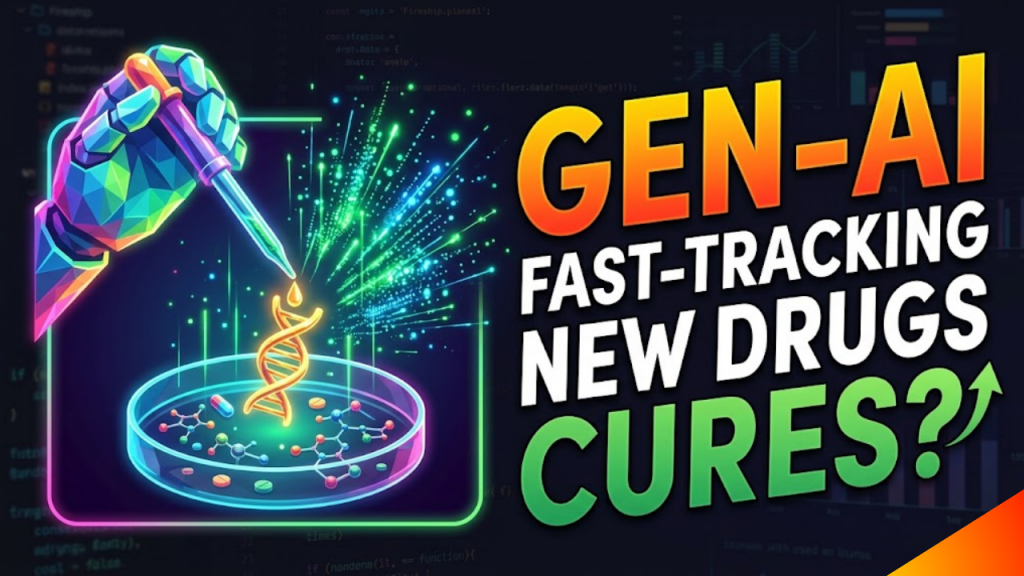
Generative AI accelerates drug discovery by moving the most expensive parts of research from the “wet lab” to a digital environment. In 2026, GenAI models no longer just analyze data; they design entirely new molecules from scratch based on a desired therapeutic goal. By simulating how these molecules bind to disease-causing proteins, AI reduces the timeline for the “Discovery Phase” from an average of 5 years down to mere months.
This technology doesn’t just make the process faster; it makes it smarter by predicting failures before a single chemical is synthesized.
3 Ways GenAI Shaves Years Off the Pipeline
In 2026, the pharmaceutical industry has shifted from “screening” existing libraries to “generative design”.
1. Precision Target Identification
Traditionally, researchers “herded” around a few known targets (like specific cancer proteins).
- The AI Shift: GenAI models analyze vast “multi-omics” datasets to identify entirely new biological targets that were previously invisible. For example, researchers at Novartis now use AI-driven digital models to turn thousands of genes on and off to find new ways to treat kidney disease.
2. Rational Molecule Design (De Novo Synthesis)
Instead of testing 1,000,000 random compounds to find a “hit,” GenAI designs the “perfect key” for a specific “protein lock.”
- The Strategy: Using Generative Chemistry, AI models computationally design millions of scaffolds and narrow them down to the top 50 candidates with the highest probability of success. Companies like Insilico Medicine have already moved drugs for fibrosis into Phase II trials in just 30 months—a process that normally takes 6 years.
3. Predicting Safety (ADMET)
Most drugs fail because they are toxic to the heart or liver.
- The Strategy: Predictive AI simulates ADMET (Absorption, Distribution, Metabolism, Excretion, and Toxicity) risks before human trials begin. By using AI to generate “activity profiles” for heart muscle cells, researchers can avoid dangerous compounds early, potentially saving billions in failed clinical trials.
The Economic Impact: Breaking Eroom’s Law
In 2026, the “Price per Successful Drug” is finally beginning to decline after 70 years of steady increases.
| Metric | Traditional Discovery (2024) | AI-Driven Discovery (2026) |
| Discovery Timeline | 4 – 6 years | 12 – 24 months |
| Success Rate (Phase I) | ~52% | 80% – 90% |
| Preclinical Costs | $2.6 Billion (Average) | Up to 30% Cost Reduction |
| Manual Lab Cycles | Thousands | Dozens (High-Confidence) |
Frequently Asked Questions (FAQ)
1. Has an AI-discovered drug been FDA-approved yet?
As of April 2026, several AI-designed drugs (like rentosertib for fibrosis) are in pivotal trials. The first full FDA approval of an end-to-end AI-generated molecule is projected for late 2026 or early 2027.
2. Can AI replace human scientists in labs?
No. AI acts as an accelerator. While AI designs the molecule and predicts its safety, human scientists are still required to validate those results in “wet labs” and manage the complex ethical and regulatory decisions.
3. What is “Virtual Screening”?
It is the process of using AI to test billions of chemical compounds in a computer simulation (in silico). This replaces the expensive and slow process of physical lab testing with chemical reagents.
4. Why do I see an Apple Security Warning on my biotech dashboard?
If your research dashboard attempts to access sensitive genomic data or local laboratory sensors via an insecure connection, you may trigger an Apple Security Warning on your iPhone or iPad.
5. What are the ethical risks of AI in medicine?
The primary concerns in 2026 include Algorithmic Bias (where drugs might work better for certain ethnicities based on training data) and Data Privacy regarding patient genetic information.
6. Which companies are leading the AI drug race?
The “Top 12” include Recursion Pharmaceuticals, Insilico Medicine, Exscientia, and Atomwise, along with giants like Novartis and Sanofi that have embedded AI into their core R&D workflows.
7. How does the EU AI Act affect drug discovery?
Starting in 2026, the EU AI Act requires “Explainability” for AI models used in healthcare. Companies must prove how an AI arrived at a specific molecular design to ensure it is safe and reliable.
8. What is “Target Identification”?
It is the first step in drug discovery: finding the specific protein or gene in the body that is causing a disease. AI is 43% more effective at identifying these “targets” than traditional methods.
Final Verdict: Navigating Biology with Intelligence
In 2026, Generative AI is the compass that helps us navigate the near-infinite complexity of human biology. By reducing trial-and-error, we are not just making drugs faster; rather, we are finally making the discovery of life-saving medicine a predictable engineering challenge.
Ready to explore the future of tech? Explore our guide on WebAssembly (Wasm) and Browser Performance to see how these simulations run at native speeds, or learn about the Zero-Trust Architecture for Web Developers to protect your biotech data.
Authority Resources
- World Economic Forum: Here’s how AI is reshaping drug discovery – Industry leaders discuss target identification and safety.
- The Scientist: Industry Leaders Predict Life Science Trends for 2026 – Predictions for the regulatory and manufacturing impact of AI.
- IntuitionLabs: AI Applications in the Drug Development Pipeline – A deep dive into the $2.6 billion AI drug market and clinical success rates.
- Capgemini: Biopharma R&D turns to AI – Executive research on the 63% adoption of AI-driven platforms.