What is a satellite mega-constellation?
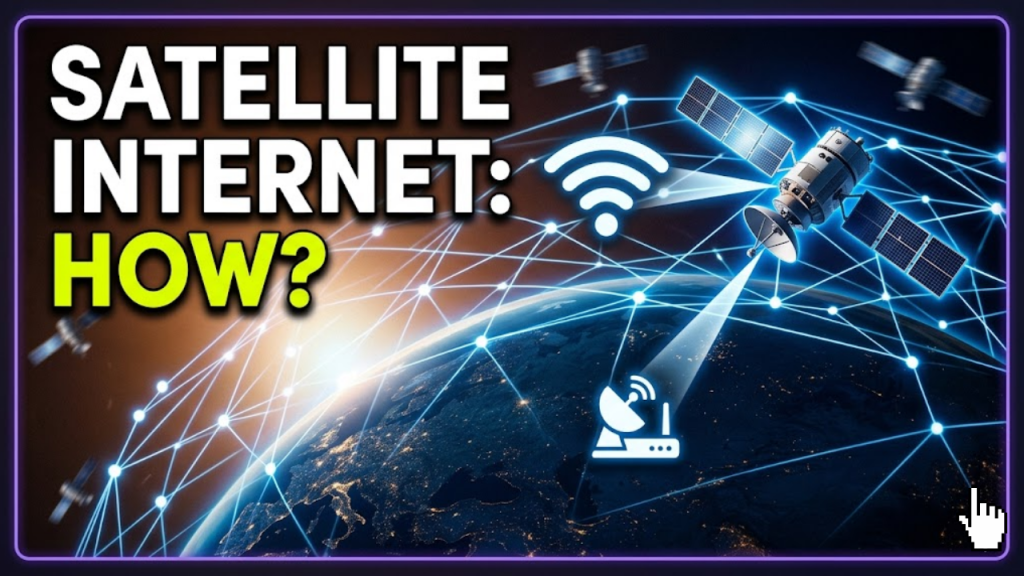
A mega-constellation is a network of thousands of small, low-orbit satellites working together to provide blanket internet coverage across the planet. Unlike traditional communication satellites, which occupy high-altitude Geostationary Orbits (GEO), these new systems operate in Low Earth Orbit (LEO). By positioning themselves just 500 to 1,200 kilometers above the surface, these satellites drastically reduce signal travel time, enabling broadband speeds that rival terrestrial fiber networks even in the most remote regions.
In 2026, this technology has effectively closed the “digital divide,” ensuring that connectivity is no longer tied to physical cables but to the sky itself.
The Architectural Shift: LEO vs. Traditional Satellites
To understand why 2026 internet feels so different, you must compare the old “Single-Point” model with the new “Mesh-Network” model.
| Feature | Traditional GEO Satellites | Mega-Constellations (LEO) |
| Orbit Altitude | ~35,786 km | 500 – 1,200 km |
| Latency (Ping) | ~600ms (High delay) | 20ms – 40ms (Low delay) |
| Coverage Strategy | Fixed (Single massive spot) | Moving (Dynamic mesh) |
| Data Throughput | Limited per satellite | High (Massive bandwidth) |
| Resilience | Single point of failure | Self-healing mesh |
The 3 Technical Pillars of Global Connectivity
Mega-constellations work by blending aerospace engineering with sophisticated software-defined networking.
1. Optical Inter-Satellite Links (Laser Mesh)
In 2026, satellites do not need to be within view of a ground station to pass data. Instead, they use Optical Space Lasers. These lasers connect satellites to one another in orbit, creating a high-speed “space mesh.” Consequently, a request originating in rural Africa can travel through the laser mesh to a ground station in Europe in milliseconds, bypassing the need for local fiber infrastructure entirely.
2. Dynamic Phased-Array Antennas
Because LEO satellites move at thousands of miles per hour, they cannot use fixed dish antennas. Modern satellites use Phased-Array Antennas, which are solid-state devices that steer signal beams electronically. This allows a single satellite to “lock onto” thousands of individual users simultaneously while traversing the sky.
3. Edge Ground Stations
Mega-constellations rely on a distributed network of ground stations, often called “Gateways.” These stations connect the space network to the terrestrial internet backbone. As a satellite orbits, it automatically performs a Seamless Handover, passing your data connection to the next satellite in the chain without dropping your stream.
Frequently Asked Questions (FAQ)
1. Does weather affect satellite internet?
Yes, but less than you think. While heavy rain or snow can cause “rain fade,” modern 2026 phased-array antennas use advanced signal processing to boost power and maintain the connection during moderate weather events.
2. Is satellite internet safe for gaming?
Yes. Thanks to the move to LEO (Low Earth Orbit), latency is now between 20ms and 40ms, which is comparable to many terrestrial cable connections. This makes online gaming and real-time video conferencing perfectly viable.
3. What is the risk of space debris?
Space debris is a significant concern. Most 2026 mega-constellations are designed with automated collision avoidance and propulsion systems to de-orbit themselves at the end of their 5-to-7-year lifespan to minimize clutter.
4. Why do I see an Apple Security Warning on my satellite connection?
If your terminal interface attempts to access internal diagnostic tools or uses unverified network routing, you may trigger an Apple Security Warning on your iPhone. Always use the official provider app.
5. Can I use these constellations with my mobile phone?
Direct-to-cell technology is growing. In 2026, several constellations now offer limited “Direct-to-Device” (D2D) connectivity, allowing standard smartphones to send SMS or basic data without specialized satellite dishes.
6. Is satellite internet cheaper than fiber?
Generally, no. Fiber offers lower costs and higher capacity. Satellite internet is a “premium connectivity” solution for remote areas where running physical cables is physically impossible or prohibitively expensive.
7. What is “Station Keeping”?
This is the process where satellites use ion propulsion (like argon thrusters) to stay in their precise orbital slot. It prevents them from drifting or colliding with others.
8. Are there too many satellites now?
There are concerns about light pollution for astronomers. In 2026, satellite operators are now required to use “darkening” coatings and specific flight angles to minimize their visibility to ground-based telescopes.
Final Verdict: The Mesh Network Above Us
In 2026, Mega-constellations have turned the sky into a global router. By moving from high-altitude “monoliths” to low-altitude “mesh swarms,” we have unlocked a future where internet access is a right, not a geographical privilege.
Ready to connect? Explore our guide on The Rise of Neumorphism in 2026 Dashboard Design to see how to build the control panels for this tech, or learn how to optimize your site in Interaction to Next Paint (INP): The New Core Web Vital.
Authority Resources
- Starlink Technology: How the Mesh Network Works – Deep dive into phase-array antennas and laser links.
- ESA: What is a Satellite Constellation? – Official definitions and space sustainability standards.
- Hello Future: The Climate Cost of Connectivity – An analysis of the environmental impact of launching constellations.
- Anywaves: LEO vs MEO vs GEO Explained – Technical comparison of orbital mechanics and bandwidth.