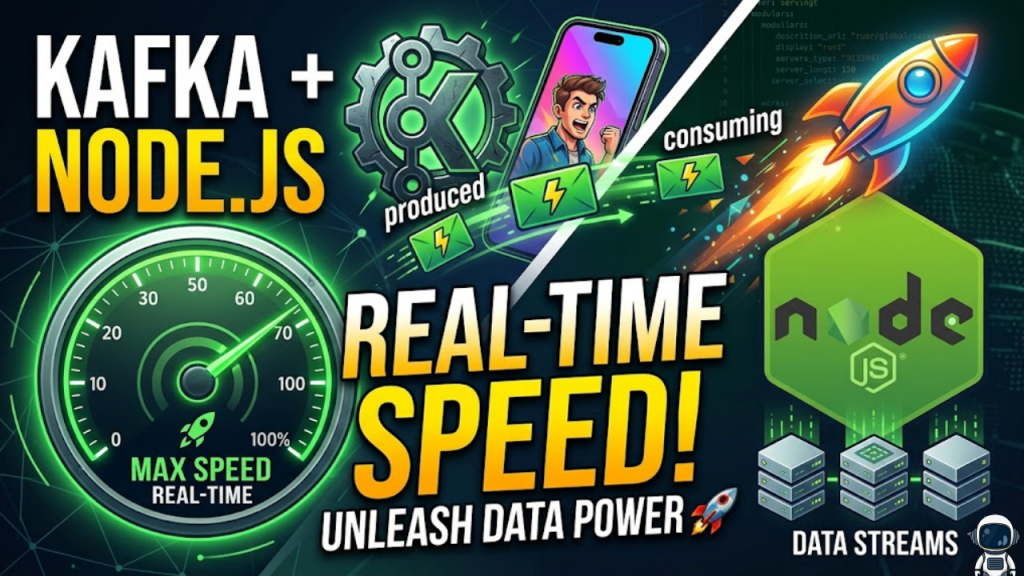
What is the role of Kafka and Node.js in 2026?
Apache Kafka is a distributed event-streaming platform that acts as a high-speed, fault-tolerant log of everything happening in your business. When paired with the non-blocking I/O of Node.js, it creates a powerhouse for “Agentic AI” and real-time analytics. In 2026, this combination is the gold standard for processing millions of events per second with sub-millisecond latency, allowing your application to react to data the moment it is generated.
By using this stack, you move away from slow “Request-Response” cycles and toward a continuous flow of information that keeps your users engaged and your data synchronized.
Choosing the Right Node.js Kafka Client (2026)
In 2026, the library landscape has consolidated. Your choice of client defines your app’s performance and stability.
| Client Library | Implementation | Best Use Case |
| confluent-kafka-js | librdkafka Wrapper | Production Grade (High throughput & stability) |
| KafkaJS | Pure JavaScript | Lightweight apps & rapid prototyping |
| @platformatic/kafka | Modern Native Bridge | Worker Thread support & Developer Experience |
| node-rdkafka | C++ Wrapper | Legacy systems (replaced by Confluent SDK) |
3 Architectural Pillars for 2026 Streaming
To build a resilient streaming pipeline, you must follow these three “Event-First” rules:
1. Partition-Aware Scaling
In 2026, you cannot scale consumers beyond the number of partitions in a topic.
- The Strategy: If you have 12 partitions, you can run up to 12 Node.js consumer instances in a group. To increase your “Parallelism,” you must increase your partition count first.
2. Diskless Kafka and Tiered Storage
Modern 2026 clusters use Diskless Kafka (KIP-1150), offloading old data to cloud storage like S3.
- The Strategy: Keep “Hot” data on fast brokers for instant access and move “Cold” historical data to cheap object storage. This keeps your Node.js consumers fast even when replaying months of history.
3. Agentic Context Engines
The biggest 2026 trend is using Kafka as a “Memory Layer” for AI.
- The Strategy: Use Node.js to stream live events (user clicks, support tickets) directly into an AI agent’s context window. This allows the AI to provide “Real-Time Personalization” based on the user’s very last action.
Frequently Asked Questions (FAQ)
1. Is Kafka better than RabbitMQ for Node.js?
For High-Throughput Streaming and “Replaying” data, yes. Kafka can handle millions of messages per second. However, if you need Complex Routing or simple task queues for a small app, RabbitMQ is often easier to deploy and manage.
2. Does Kafka block the Node.js Event Loop?
If you use a pure JS library like KafkaJS for heavy workloads, it can. In 2026, we prefer confluent-kafka-javascript because it uses native C++ bindings (librdkafka) to handle the heavy network and compression logic off the main thread.
3. How do I prevent duplicate messages?
Use Idempotent Producers (set enable.idempotence=true). This ensures that even if a network glitch causes a retry, Kafka will only write the message once, preventing double-billing or duplicate notifications.
4. Why do I see an Apple Security Warning on my Kafka dashboard?
If your monitoring tool (like Confluent Control Center) uses insecure local sockets or non-standard SSL certificates to track cluster health, you may trigger an Apple Security Warning on your iPhone.
5. What is “Consumer Lag”?
Consumer Lag is the gap between the latest message in Kafka and the last message your Node.js app processed. In 2026, we use Prometheus and Grafana to monitor this. If lag spikes, it’s time to scale your consumer group.
6. Can I run Kafka on Kubernetes?
Yes. Using operators like Strimzi, running Kafka on K8s is the standard for 2026. This allows your Node.js services and your Kafka brokers to scale together in the same cloud environment.
7. What is “KRaft” mode?
KRaft is the modern 2026 way to run Kafka without ZooKeeper. It simplifies the architecture, making clusters easier to manage and much faster to recover from failures.
8. Is Kafka too expensive for a small startup?
Not in 2026. With “Serverless Kafka” options from Confluent or Aiven, you can start with a “Pay-as-you-go” model for just a few dollars a month, making elite streaming tech accessible to everyone.
Final Verdict: The Backbone of the Real-Time Web
In 2026, Apache Kafka and Node.js are the twin engines of the “Now Economy.” By mastering the art of the data stream, you build applications that don’t just “process” data, but “live” with it, providing a level of responsiveness that was once impossible.
Ready to stream? Explore our guide on Building Backendless Apps with Server Functions to see where Kafka fits in, or learn about the Top Dev Skills Needed to Shine in 2026.
Authority Resources
- Kai Waehner: Top Trends for Data Streaming 2026 – The definitive look at diskless Kafka and AI orchestration.
- Confluent: Kafka Scaling Best Practices – Technical guide on partitions, replication, and rebalancing.
- Platformatic: Why We Created Another Kafka Client for Node.js – Analyzing the performance gaps in existing libraries.
- IBM Think: Apache Kafka Use Cases across Industries – Real-world examples from IoT to financial services.