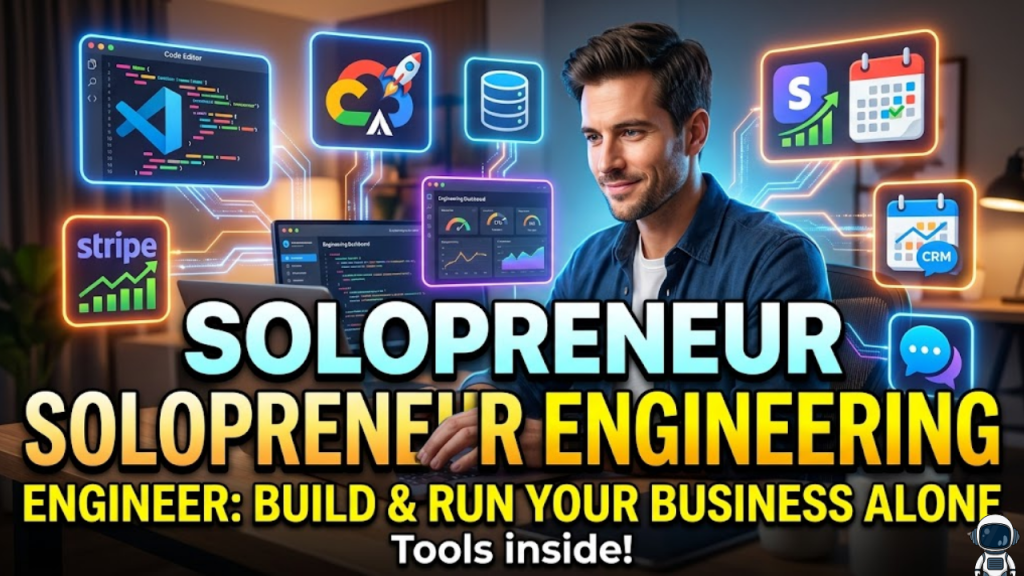
What is Solopreneur Engineering in 2026?
Solopreneur Engineering is the practice of using high-leverage digital tools to build, market, and scale a technical business without hiring employees. In 2026, this shift is powered by “Vibe Coding” and Multi-Agent Orchestration. You no longer need a DevOps team or a QA department; instead, you use AI agents that handle everything from infrastructure deployment to automated customer support, allowing you to focus 100% on high-level strategy and distribution.
In 2026, independence is no longer a “gig”; it is a scalable economic force.
The 2026 “Team of One” Tech Stack
To compete with agencies in 2026, your stack must be modular, automated, and AI-native. Successful solo engineers build “Systems,” not just “Projects”.
| Business Layer | 2026 Standard Tool | Why It’s Essential |
| Product Development | Lovable / Cursor | Ship full-stack apps 5x faster with AI |
| Project & Task Ops | Motion / Linear | AI reschedules your day as priorities shift |
| Biz Automation | n8n / Make.com | Connect 100+ apps into self-running workflows |
| Customer Support | Tidio AI / Chatbase | AI agents resolve 80% of FAQs without you |
| Revenue & Tax | Lemon Squeezy | Handles global tax compliance automatically |
3 Pillars of a Scalable Solo Business
In 2026, the most successful engineering solopreneurs follow a “Build → Automate → Distribute” playbook.
1. Vibe Coding for Rapid Prototyping
In 2026, “Vibe Coding” allows you to describe features in plain language. Tools like GitHub Spark or Lovable then generate functional code, database schemas, and API integrations. This reduces the time to launch an MVP from months to days, allowing you to test 10 ideas in the time it used to take to build one.
2. Micro-Agent Orchestration
You are the manager; the AI agents are your “staff.”
- Ops Agents: Tools like Lindy or Relevance AI handle your inbox triage, CRM updates, and scheduling.
- Dev Agents: Tools like Flowise AI allow you to build custom reasoning flows that audit your code for security and performance in the background.
3. The “Build in Public” Distribution
In 2026, your personal brand is your CV. By sharing your wins, failures, and technical architecture on platforms like X (Twitter) or LinkedIn, you build a “Trust Asset” that converts reach into steady traffic without a marketing team.
Frequently Asked Questions (FAQ)
1. Can one person really run a six-figure SaaS in 2026?
Yes. 2026 data shows that solo founders now build and launch Micro-SaaS products in 4 to 12 weeks. These businesses often generate between $50K and $3M annually with minimal overhead.
2. What is the biggest “time vampire” for solopreneurs?
Administrative work like invoicing, manual social media posting, and client onboarding. In 2026, smart founders automate these areas using AI to reclaim over 20 hours per week.
3. Do I need to be a “Senior Engineer” to start?
Not necessarily. While technical skills help with verification, No-Code to Pro-Code tools have democratized tech creation. In 2026, your ability to “architect” a solution is more valuable than your ability to “write” the code.
4. Why do I see an Apple Security Warning on my solo-built app?
If your app uses unverified third-party libraries for AI or attempts to access local device sensors without secure HTTPS scoping, you may trigger an Apple Security Warning on your iPhone.
5. What is a “Micro-Offer”?
This is a 2026 trend where you sell a single, high-value outcome (e.g., “I will set up your AI lead-gen engine in 48 hours”) rather than a giant, open-ended consulting contract. It is easier to deliver and scales better for a solo operator.
6. How do I handle taxes and international payments?
Use a Merchant of Record like Lemon Squeezy. They act as the seller, meaning they handle all global VAT/Sales Tax, fraud protection, and chargebacks so you don’t have to.
7. What is “Freedom as the KPI”?
Successful 2026 solopreneurs track “Freedom” rather than just revenue. The goal is to build a business that supports your life, allows for “Calm” decision-making, and avoids the hustle-driven burnout of previous decades.
8. Is this just “Hustle Theater”?
No. When done right, this is System-Driven Engineering. You aren’t “hustling” harder; you are using better tools and modular stacks to work lighter and more creatively.
Final Verdict: Become the Architect of Your Destiny
In 2026, the barrier to entry for building a serious engineering business has collapsed. By using AI Agents, Automated Operations, and Niche Specialization, you can build a lean, resilient, and highly profitable company that reflects who you are.
Ready to launch? Explore our guide on How to Become a Web Developer in 2026 to master the foundations, or learn about Why Passkeys are Replacing Passwords to secure your business infrastructure.
Authority Resources
- PrometAI: The Rise of the Solopreneur Tech Stack in 2026 – A deep dive into modular architecture for solo founders.
- Zoom: The State of Solopreneurship in 2026 – Research on how AI fuels independence and business growth.
- Lovable: Top 10 Small Business Trends Shaping 2026 – Insights into “No-Code to Pro-Code” and autonomous app building.
- Entrepreneur: Why Solopreneurship Is Set to Hit a Record High – Statistics on the $1.7 trillion solo founder economy.