What are bio-computers?
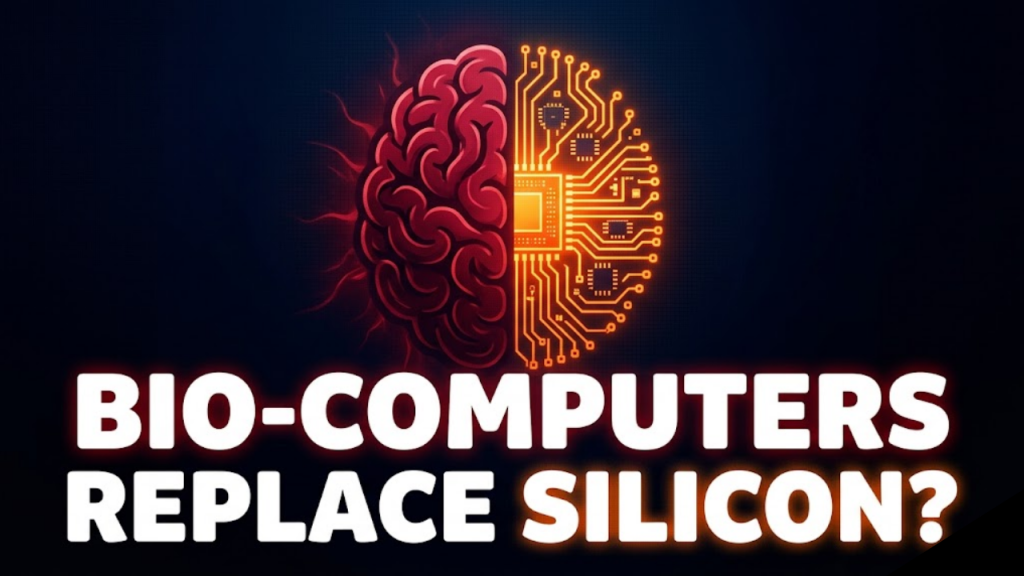
Bio-computers are hybrid systems that use living biological materials, such as lab-grown brain organoids or engineered DNA, to perform computational tasks. In 2026, this field is known as Organoid Intelligence (OI). Unlike a standard PC that uses silicon transistors and electricity, a bio-computer uses clusters of living neurons (mini-brains) organized into 3D structures. These neurons “compute” by forming new synaptic connections, allowing them to learn, adapt, and process information using a fraction of the energy required by traditional hardware.
While they are not yet ready to run your video games, bio-computers represent a massive shift toward carbon-neutral AI.
Silicon vs. Biology: The 2026 Efficiency War
In 2026, we have officially hit the thermal limits of silicon. Bio-computers offer a radical alternative because they don’t fight against physics; they use evolved biological efficiency.
| Feature | Silicon Chips (NVIDIA/Intel) | Bio-Computers (OI Platforms) |
| Power Consumption | Megawatts (Supercomputers) | ~20 Watts (Body Temp) |
| Cooling Needs | Massive (Liquid/Air fans) | Minimal (Ambient liquid broth) |
| Learning Style | Brute-force training | Biological Plasticity |
| Clock Speed | Billions of cycles/second | Millions of cycles/second |
| Efficiency Gap | 1x | 1,000,000x More Efficient |
How a Bio-Computer Works (Step-by-Step)
To build a “living processor” in 2026, scientists use a five-step “Human-in-the-Loop” process:
- Cellular Reprogramming: Scientists take a simple skin biopsy and reprogram the cells into induced pluripotent stem cells (iPSCs)—the “blank slates” of biology.
- Neural Differentiation: These cells are coaxed into becoming neurons and then encouraged to self-organize into a 3D Brain Organoid.
- The Interface (MEA): The organoid is grown directly onto a Micro-Electrode Array. This acts as the bridge, allowing digital computers to send electrical “inputs” and record neural “outputs”.
- Training via Plasticity: Using dopamine signaling or patterned stimulation, researchers “teach” the neurons to recognize patterns or control software (like the game Pong).
- Continuous Maintenance: The system acts like a specialized incubator, providing a nutrient-rich broth and precise gases (N2 and CO2) to keep the “processor” alive.
Frequently Asked Questions (FAQ)
1. Could bio-computers replace my silicon laptop?
Not in the foreseeable future. In 2026, bio-computing is a supplement, not a replacement. It is being designed for massive, power-hungry AI workloads in data centers, not for general-purpose home computing.
2. Is it ethical to use “mini-brains” for computing?
This is the biggest debate of 2026. While organoids lack a sensory body or consciousness, scientists and ethicists are developing guidelines to ensure “living computers” are treated with a unique set of rights as they grow more complex.
3. What is the “FinalSpark Neuroplatform”?
It is one of the first commercially available bio-computing platforms in 2026. It allows researchers to rent access to 16 brain organoids via the cloud to run experiments on biological learning.
4. Why do I see an Apple Security Warning on my bio-interface?
If you are using an iPhone to monitor a bio-data center and the app attempts to use unverified wireless bio-electronics or non-standard Bluetooth bridges, you may trigger an Apple Security Warning on your iPhone.
5. Can bio-computers get “sick”?
Yes. Unlike silicon, biological processors are fragile. They require precise temperatures and can be affected by viruses or nutrient imbalances, meaning they have a limited “lifespan” compared to a chip.
6. What is “Organoid Intelligence” (OI)?
OI is the official name for the field of study that integrates brain organoids into computing systems to leverage the natural learning abilities of human tissue.
7. How are they used in medicine today?
In 2026, bio-computers are used as “Neural Avatars.” Doctors grow an organoid from a specific patient’s cells to test how a drug (like for Alzheimer’s) will react to that specific person’s genetic makeup.
8. What is the “Power Wall”?
It is a 2026 term for the point where silicon chips require more energy to cool than they use to compute. Bio-computers bypass this wall because they operate at body temperature.
Final Verdict: The Era of “Living” AI
In 2026, Bio-computers have proved that the future of intelligence may not be artificial. While silicon will always win on speed, biology wins on efficiency and adaptation. By merging the two, we are entering an era of “Bio-Hybrid” systems that could solve the world’s most complex problems without destroying the planet’s energy grid.
Ready to explore more frontiers? Learn about WebAssembly (Wasm) and Browser Performance to see how silicon still leads in the browser, or discover the Top Dev Skills Needed to Shine in 2026.
Authority Resources
- Wikipedia: Biological Computing – The foundational science of biochemical and bioelectronic systems.
- BrainAccess: The Dawn of Biocomputers – Exploring the fusion of neuroscience and computer engineering.
- FinalSpark: Inside the Neuroplatform – Technical specs on the world’s first commercial living computer.
- Bleeding Edge Biology: Organoid Intelligence Rise – Why the next leap in AI won’t be a faster chip, but a living one.