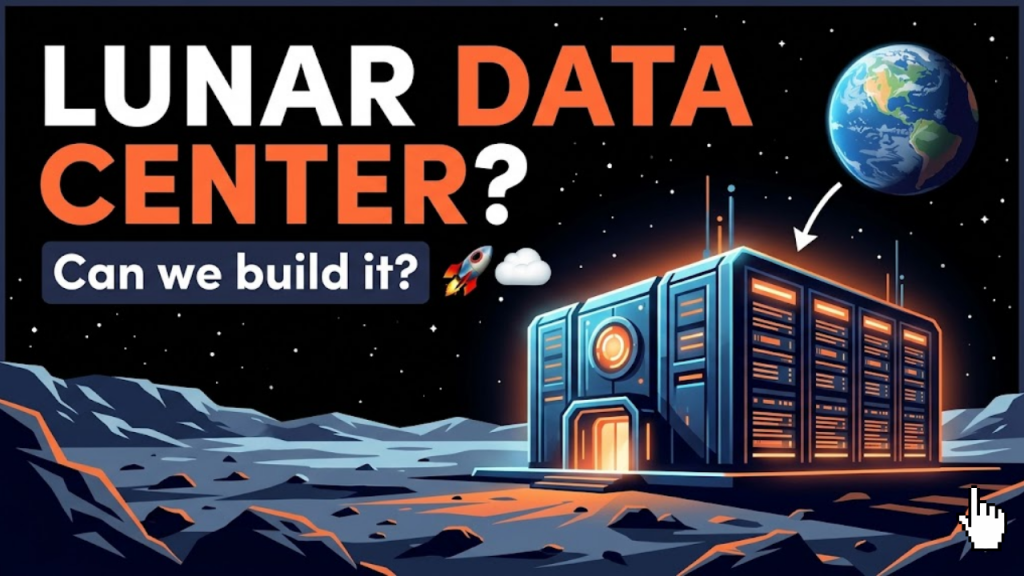
Is it possible to build a data center on the Moon?
Yes, and in 2026, it is already happening. As of early 2026, private companies have successfully tested prototype data payloads on the lunar surface, proving that we can store, process, and transmit data back to Earth from the Moon. Building a permanent lunar data center is a prerequisite for the Artemis program and the upcoming “Lunar Economy.” It serves as a localized hub for lunar rovers, 3GPP cellular networks, and scientific instruments, allowing them to process massive telemetry data without the 2.5-second round-trip latency to Earth.
Establishing a “Lunar Region” in the cloud is no longer science fiction; rather, it is a strategic infrastructure goal for the early 2030s.
Why the Moon? 3 Unique Advantages for Data
In 2026, terrestrial data centers are struggling with energy costs and land use. The Moon offers three “unfair” advantages for high-density computing.
- Natural Radiative Cooling: The Moon’s permanently shadowed regions (PSRs) can reach temperatures as low as -173°C. This provides a massive, natural heat sink, though engineers must use large radiators since there is no air to carry heat away via fans.
- Disaster Recovery (The “3-2-1” Rule): A lunar data center provides the ultimate “off-site” backup. Storing a copy of human knowledge on the Moon protects it from terrestrial catastrophes like nuclear war or asteroid impacts.
- Unlimited Solar Energy: Without an atmosphere or weather, lunar solar panels can capture 36% more solar irradiance than those on Earth, providing a constant stream of free, clean energy for AI processing.
The 2026 Lunar Data Roadmap
The transition from Earth-bound servers to lunar storage is happening in three distinct phases.
- Proof of Concept (2024-2025): Companies like LoneStar Data Holdings sent the first data center payloads to the Moon via Intuitive Machines landers. They successfully transmitted video, documents, and AI analytics between the Moon and Earth.
- Orbital Data Centers (2026-2028): Before building on the surface, firms are launching “Data Satellites” into lunar orbit or the L1 Lagrange Point. These act as high-speed relays for the growing fleet of robotic landers attempting landings this year.
- Surface Facilities (2030s): Full-scale, modular data centers will be deployed at the lunar south pole. These will use Solid-State Drives (SSDs), as traditional hard drives fail in the vacuum and radiation of space.
Critical Challenges for Lunar Engineers
Despite the advantages, the Moon is a hostile environment for hardware.
- Radiation Hardening: Cosmic rays can flip bits in a server’s memory, leading to data corruption. In 2026, we use specialized software and robust shielding (gold/silver foil) to protect the silicon.
- Lunar Dust (Regolith): Moon dust is sharp, abrasive, and statically charged. It can clog seals and scratch optical sensors. Future data centers must be completely sealed or buried under 2 meters of soil for protection.
- The Latency Gap: While great for the Moon, lunar data is too slow for real-time Earth tasks (like gaming). It is strictly for asynchronous backup, long-term archiving, and local lunar operations.
Frequently Asked Questions (FAQ)
1. Who is building the first lunar data center?
LoneStar Data Holdings is currently the leader. They successfully tested their “Freedom” data payload in 2025 and plan to have permanent surface facilities by the early 2030s.
2. How much does it cost to send a server to the Moon?
While costs are falling, it currently takes millions of dollars. However, Google research suggests that if launch costs drop to $200/kg, space-based data centers could become cost-competitive with ground-based ones due to free cooling and power.
3. Does the Moon have an internet connection?
Yes. Projects like Lunar 3GPP are working to deploy a cellular network on the Moon to support Artemis II and III astronauts, rovers, and permanent data hubs.
4. Why do I see an Apple Security Warning on my lunar data app?
If your space-data dashboard uses unverified encrypted bridges or non-standard authentication methods to communicate with lunar relays, you may trigger an Apple Security Warning on your iPhone.
5. Can we use the Moon for AI training?
Proponents argue that the Moon is perfect for MW-scale AI compute because it won’t strain the terrestrial power grid and has ample space for massive server farms.
6. How do you cool a server in a vacuum?
Since there is no air, you must use Radiators. Ammonia-filled pipes carry heat away from the servers and radiate it out into the cold void of space as infrared light.
7. What happens to the “E-waste” on the Moon?
This is a major sustainability concern. Recycling electronics in space is currently impossible, leading to fears of “orbit pollution” and permanent lunar junkyards.
8. Is lunar data sovereign?
Space law currently provides a unique foundation for Data Sovereignty. Because the Moon is not a nation, data stored there can exist under a specialized international legal framework.
Final Verdict: The Cloud is Moving Higher
In 2026, the Moon is becoming our “Off-world Server Room.” By building a Lunar Data Center, we aren’t just supporting space missions; we are creating a permanent, resilient archive for humanity that is literally beyond the reach of terrestrial vulnerabilities.
Ready to explore the frontier? Check out our guide on The Impact of WebAssembly (Wasm) on Browser Performance to see how we handle heavy data processing, or learn about Building Backendless Apps with Server Functions.
Authority Resources
- Lonestar Data Holdings: Lunar Data Center Achievement – Updates on the successful “Freedom” data payload missions.
- Space.com: The 2026 Moon Rush – A breakdown of the commercial missions landing on the Moon this year.
- RCR Wireless: The Lunar 3GPP Project – How digital twins and cellular networks are supporting future moon missions.
- NASA: Onboard Mass Data Storage Specs – The technical requirements for hardware surviving the lunar environment.