What is a Private 5G Network in 2026?
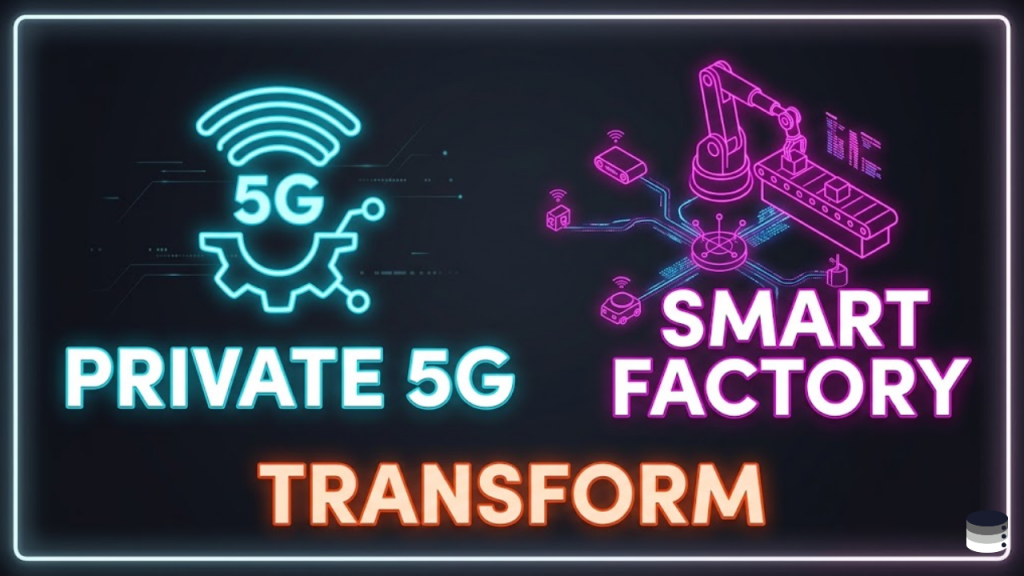
A Private 5G network is a dedicated, secure cellular network built specifically for a single industrial site. Unlike public 5G, which shares bandwidth with millions of consumer phones, a private network uses dedicated antennas and a licensed spectrum that the manufacturer fully controls. This allows the factory to define its own latency, coverage, and security protocols, creating a “walled garden” for industrial-grade mobile connectivity.
In 2026, this technology has moved from pilot projects to the “linchpin” of smart manufacturing, providing the reliable data foundation required for AI, robots, and digital twins.
The 3 Pillars of 5G Factory Transformation
In 2026, the shift to Private 5G is driven by three core technical advantages over traditional Wi-Fi and wired systems.
1. Ultra-Low Latency & Critical Communication
5G is the first wireless technology compatible with “critical communications”.
- Near-Zero Latency: With latency as low as 1ms, Private 5G allows machines to communicate in real-time. On assembly lines where variations of a tenth of a second can ruin product quality, this continuous signal prevents costly disconnections.
- Predictable Performance: Unlike Wi-Fi, which can degrade as more devices are added, Private 5G supports up to one million devices per square kilometer without losing speed.
2. “Untethered” Flexibility
One of the most practical benefits of 5G is the elimination of thousands of miles of network cables.
- Wireless Retrofitting: Manufacturers can modernize old factories in months rather than years because they no longer have to tear up floors to run cables.
- Plug-and-Play Mobility: When market demands change, production lines can be reconfigured instantly. Machines are simply moved and reconnected to the wireless network without any rewiring downtime.
3. Edge AI and Sovereign Data
In 2026, the network is becoming “AI-native”.
- Local Processing: Private 5G enables Edge Computing, where data is analyzed locally on the factory floor rather than in a distant cloud. This speeds up real-time decision-making for autonomous systems.
- Sovereign AI: By keeping sensitive production data on a private network and private cloud, factories can use Large Language Models (LLMs) to optimize “secret recipes” without risking data leaks to public AI services.
2026 Use Cases: Real-World Impacts
Private 5G enables multiple high-value scenarios that were previously impossible with wireless tech.
- Autonomous Mobile Robots (AMRs): 5G allows AMRs and AGVs to move freely through expansive, intricate environments without magnetic strips or fixed paths.
- Real-Time Quality Control: High-definition video cameras can stream visual data to the edge for instant defect detection using computer vision.
- AR for Workforce Empowerment: Workers wearing Augmented Reality (AR) headsets receive interactive digital overlays to guide them through complex repairs or training, significantly reducing human error.
- Digital Twins: Factories create 3D virtual copies of machinery to run simulations and predict the outcome of layout changes before they happen.
Frequently Asked Questions (FAQ)
1. Why is 5G better than Wi-Fi for a factory?
Wi-Fi struggles in environments with lots of metal and cannot guarantee the “Deterministic Performance” needed for critical machine control. 5G provides a licensed, interference-free spectrum that ensures a robot never stops moving due to a signal drop.
2. Is a Private 5G Network secure?
Yes. Private 5G offers Built-in Isolation and Encryption. Because the network is completely separate from the public internet and consumer carriers, it protects a company’s data and intellectual property (IP) from external cyberattacks.
3. Does it help with sustainability?
Yes. 5G allows for “Massive Machine Communication” with longer battery life for IoT sensors. This helps monitor energy usage and optimize performance to reach carbon neutrality goals.
4. Why do I see an Apple Security Warning on my 5G device?
If your industrial 5G device or rugged tablet attempts to connect to an unverified private network or uses non-standard encryption protocols on an iOS device, you may trigger an Apple Security Warning on your iPhone.
5. What is “Smart Slicing” in 2026?
Network Slicing allows a factory to divide its one physical 5G network into multiple virtual “slices”. For example, one slice can be dedicated to ultra-reliable robot control, while another handles standard office traffic, ensuring critical tasks are always prioritized.
6. Can small factories afford Private 5G?
In 2026, “Easy-fit” solutions are emerging for smaller plants. While large enterprises use custom deployments, smaller firms often use Hybrid 5G or “Plug-and-play” kits that are more cost-effective.
Final Verdict: The Deterministic Data Plane
In 2026, Private 5G has transformed fragmented, unreliable data streams into a Trusted, Deterministic Data Plane. It provides the high-capacity “nervous system” that allows Industry 4.0 initiatives to finally deliver on their full promise of intelligence, safety, and speed.
Ready to modernize your operations? Explore our guide on Converting Your WordPress Site into a PWA to see how app-like tech works on the web, or learn about the Impact of WebAssembly (Wasm) on Browser Performance for heavy data processing.
Authority Resources
- Ericsson: The Data-Driven Factory and Private 5G – A deep dive into deterministic performance and OT data gaps.
- Nokia: Smart Manufacturing and 5G Private Wireless – Strategies for achieving carbon neutrality and productivity through connectivity.
- IIoT World: Private vs Public vs Hybrid 5G – A practical guide to network types and sovereign AI.
- Three Group Solutions: Driving the Future of the Factory Floor – Comparison of 5G, Wi-Fi, and wired systems in Industry 4.0.