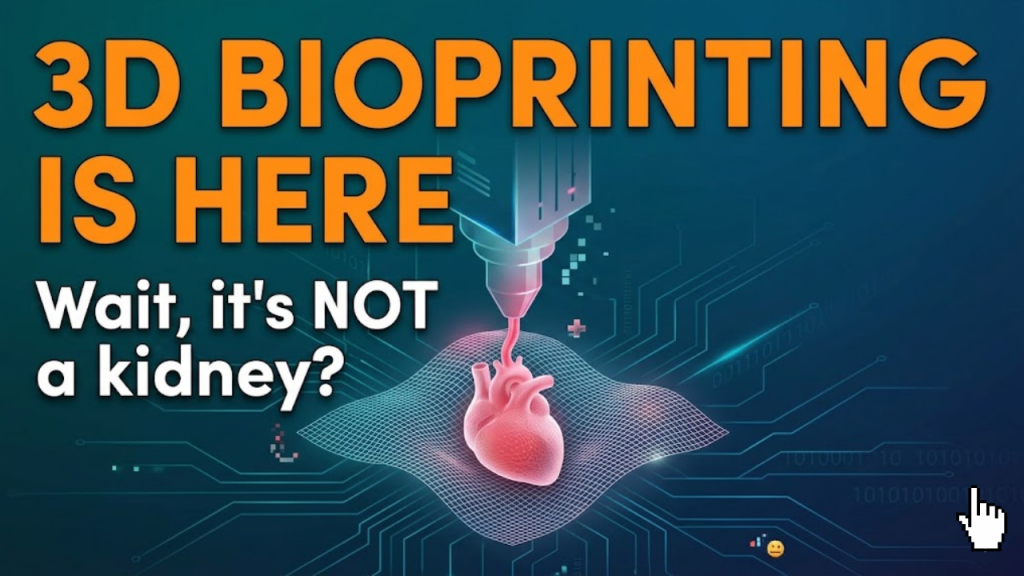
What is 3D bioprinting in 2026? 3D bioprinting is an additive manufacturing process that uses “Bio-inks”, mixtures of living cells and biocompatible material, to build functional, tissue-like structures layer by layer. In 2026, this technology has transitioned from proof-of-concept laboratory studies to early clinical applications. By utilizing computer-aided design (CAD) based on a patient’s own medical imaging, scientists can now print customized tissues that replicate the specific spatial and biological complexity of human organs.
This technology offers a sustainable alternative to the global organ donor shortage by creating personalized implants that reduce the risk of immune rejection.
The 3 Pillars of Functional Bioprinting in 2026
To create tissue that actually “works” inside a human body, bioprinting must master three critical technical challenges.
1. Vascularization (The “Blood Flow” Problem)
A major breakthrough in 2026 is the successful integration of micro-vascular networks within printed tissues.
- The Strategy: Using multimaterial printing, researchers “co-print” parenchyma (functional) cells alongside sacrificial fugitive inks that are later washed away to leave open channels. These channels are then lined with endothelial cells to create functional blood vessels, allowing oxygen and nutrients to reach thick tissues exceeding 1 cm in thickness.
2. Advanced Bio-ink Design
Modern bio-inks in 2026 do more than just hold cells; they actively promote tissue growth.
- The Implementation: We use Recombinant Human Collagen and smart biomaterials that mimic the native extracellular matrix (ECM). These inks provide the mechanical stability needed for the structure while signaling the cells to multiply and specialize into specific tissue types.
3. Bioreactor Maturation (Post-Processing)
A printed structure is not immediately functional. In 2026, the Bioreactor Phase is non-negotiable.
- The Implementation: After printing, the construct is placed in a bioreactor, a controlled environment that supplies precise levels of oxygen and nutrients. This “trains” the tissue, ensuring it gains the biological activity and mechanical strength required for a successful transplant.
Current Transplants: What is Possible in 2026?
While full heart or lung transplants remain in the future, several bioprinted tissues have reached significant milestones.
- Skin Grafts: Used primarily for burn victims, bioprinted skin allows for rapid wound healing and integrates seamlessly with the patient’s existing tissue.
- Cartilage and Bone Repair: Surgeons now use 3D bioprinted “plugs” to treat joint defects and osteoarthritis, with some projects showing the ability to reverse joint damage within weeks.
- Liver and Kidney Models: While not yet used for full organ replacement, bioprinted liver and kidney “patches” are being tested to restore partial function in patients with end-stage organ failure.
Frequently Asked Questions (FAQ)
1. When will full bioprinted organs be available for transplant?
In 2026, we are in the “early clinical application” phase. While simple tissues (skin, bone) are in use, complex organs like hearts are expected to take another 5 to 10 years due to the immense complexity of their vascular and electrical systems.
2. Does the body reject bioprinted tissue?
No, the risk is significantly lower. Because these tissues are printed using a patient’s own Stem Cells, the body recognizes the transplant as “self,” which can eliminate the need for life-long immunosuppressant drugs.
3. What is the role of AI in bioprinting?
In 2026, AI integration is used to predict how cells will grow after they are printed. AI helps optimize the bio-ink composition and the printing path to ensure maximum cell viability and precision.
4. Why do I see an Apple Security Warning on my medical portal?
If your healthcare provider’s platform attempts to access sensitive biometric data or high-resolution medical scans without a secure, encrypted connection, you may trigger an Apple Security Warning on your iPhone.
5. Is 3D bioprinting expensive?
Currently, yes. High costs for bioprinting platforms and specialized bio-inks remain a barrier to widespread adoption. However, as the market scales toward $16 billion by 2034, costs are expected to drop significantly.
6. What is “4D Bioprinting”?
This is an emerging 2026 trend where bioprinted structures can change shape or function over time in response to external stimuli, such as temperature or pH levels, allowing for even more dynamic tissue growth.
7. Where is the leader in this technology?
North America holds the largest market share (38%) due to heavy research funding, but the Asia-Pacific region (China, Japan, South Korea) is the fastest-growing market in 2026.
8. Does this replace animal testing?
Yes, this is one of the biggest immediate impacts. Bioprinted “Organ-on-a-Chip” models provide more accurate human-relevant data for drug testing than animal models, leading to a massive decrease in animal testing across the pharmaceutical industry.
Final Verdict: The End of the Waiting List
In 2026, 3D Bioprinting has moved from science fiction to surgical reality. By printing with a patient’s own cells and mastering the art of vascularization, we are building a future where the organ donor waiting list is a relic of the past.
Ready to explore more med-tech? Explore our guide on Zero-Trust Architecture for Web Developers to see how medical data is secured, or discover how the WebAssembly (Wasm) is powering high-resolution 3D medical viewers.
Authority Resources
- Fortune Business Insights: 3D Bioprinted Human Tissue Market – Market size, growth projections, and key industry players.
- PMC: Advances in 3D Bioprinting for Medical Application – Deep dive into the technical challenges of vascularization and cell viability.
- Frontiers: The Rise of 3D Bioprinting Advancements – Exploring the use of bioprinting in disease modeling and personalized medicine.
- Precedence Research: 3D Bioprinted Human Tissue Market Trends – A breakdown of tissue types and technological growth across regions.