How does AI stop dangerous drug-to-drug interactions (DDIs)?
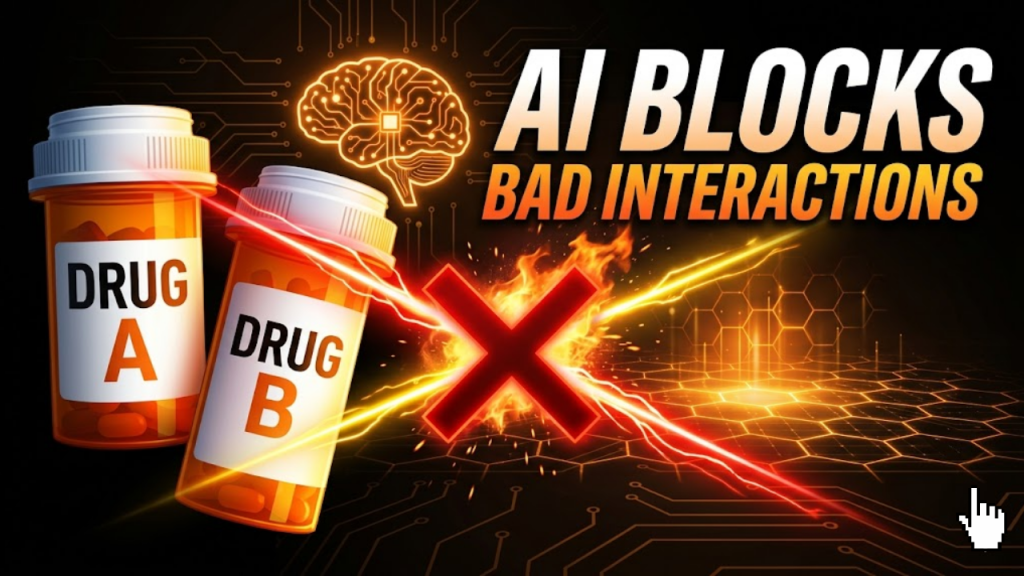
In 2026, digital pharmacies use AI as a real-time clinical “safety layer” that goes far beyond simple database lookups. Modern AI systems use Graph Neural Networks (GNNs) and systems pharmacology to analyze a patient’s entire medical history. Unlike older systems that only flagged “Major” interactions, 2026 AI models predict synergistic and antagonistic risks based on specific patient demographics, lab results, and genomic data.
By moving from reactive alerts to predictive screening, these pharmacies catch life-threatening combinations before a single pill is ever dispensed.
3 Ways AI Detects Interactions in 2026
Digital pharmacies have integrated AI directly into their Clinical Decision Support Systems (CDSS). This allows for deep, context-aware screening.
1. Cross-Referencing Real-World Data (RWD)
Traditional systems relied on static lists of known interactions. In 2026, AI models analyze Real-World Data from millions of Electronic Health Records (EHRs). If a specific drug combination has caused even a minor trend in declined kidney function or increased falls in elderly patients, the AI flags it for the pharmacist to review.
2. Pharmacogenomic Analysis
Many interactions depend on a patient’s DNA.
- The Strategy: AI tools analyze genetic markers to predict how a patient will metabolize certain drugs. If a patient is a “poor metabolizer” of a specific enzyme, the AI flags a risk that a standard database might miss, preventing toxicity or treatment failure from the start.
3. Detecting “Polypharmacy” Risks
For patients taking five or more medications, the risk of a DDI spikes exponentially.
- The Strategy: AI uses Knowledge Graphs to simulate how multiple drugs interact with the same physiological pathways. It specifically looks for “additive” effects (where two drugs combined become too strong) and “antagonistic” effects (where one drug cancels out another).
The 2026 Workflow: AI as the Navigator, Not the Captain
Digital pharmacies emphasize that AI does not replace the pharmacist. Instead, it serves as a high-speed assistant.
- Scanning for Errors: AI systems double-check medication selections to reduce mix-ups between “look-alike” or “sound-alike” drugs.
- Verifying Dosing: The system cross-references the dose against the patient’s weight, age, and lab results (like creatinine levels for kidney function) to ensure the prescription is safe for their specific body.
- Flagging Silent Issues: AI can detect sudden changes in refill frequency or repeated patient questions about side effects, alerting the team to a potential interaction that hasn’t been clinically diagnosed yet.
Frequently Asked Questions (FAQ)
1. Can AI catch interactions that doctors miss?
Yes. Studies in 2026 show that AI clinical tools often detect medication problems that human clinicians overlook, especially in complex cases involving polypharmacy in older adults.
2. Does this AI use ChatGPT?
While Large Language Models (LLMs) can identify general interactions, digital pharmacies usually use specialized Clinical AI models (like GNNs) for final safety checks. These models are trained on validated pharmacological data rather than just general web text.
3. What is “Pharmacovigilance” in 2026?
This is the process of monitoring drug safety after approval. AI has revolutionized this by automating the collection of safety data from EHRs and patient feedback, allowing for “Predictive Adverse Event Management”.
4. Why do I see an Apple Security Warning on my health app?
If your digital pharmacy app attempts to access your health records without a secure, encrypted bridge (like FHIR), you may trigger an Apple Security Warning on your iPhone.
5. What are “Synergistic” effects?
These occur when two drugs work together to produce an effect much stronger than either would alone. For example, combining certain depressants can dangerously increase the risk of respiratory issues, a risk AI monitors in real-time.
6. Will AI raise the cost of my prescriptions?
No. By catching interactions early, AI reduces adverse drug reactions (ADRs). Consequently, this lowers overall healthcare costs and prevents expensive emergency room visits.
7. What is a “Clinical Decision Support System” (CDSS)?
It is the software platform that combines patient data with clinical knowledge. In 2026, these systems match a patient’s unique info to a clinical database to surface specific safety recommendations.
8. Is my data safe with a digital pharmacy?
In 2026, pharmacies must follow strict data interoperability and privacy laws. Most “Clinical AI” is designed to analyze data without moving it from secure servers, ensuring your medical history remains private.
Final Verdict: AI as the Ultimate Safety Net
In 2026, digital pharmacies have moved from being “pill-shippers” to “safety providers.” By using AI to navigate the complex web of drug-to-drug interactions, they provide a level of personalized care and safety that was previously impossible at scale.
Ready to secure your health-tech? Explore our guide on Zero-Trust Architecture for Web Developers or learn about modern data safety in Why Passkeys are Replacing Passwords in 2026.
Authority Resources
- Frontiers: Advancing drug-drug interactions research with AI – Comprehensive review of predictive AI in clinical pharmacology.
- Pharmacy Times: How AI is Transforming Pharmacy Practice – Analysis of AI’s role in detecting dangerous interactions and personalizing care.
- PMC: AI in the Management of Polypharmacy – Research on how AI identifies inappropriate medications in older adults.
- ClinicSmart: AI in Pharmacy Benefits and Risks 2026 – A look at real-time data analysis and adverse event reporting.