What is Direct-to-Cell technology?
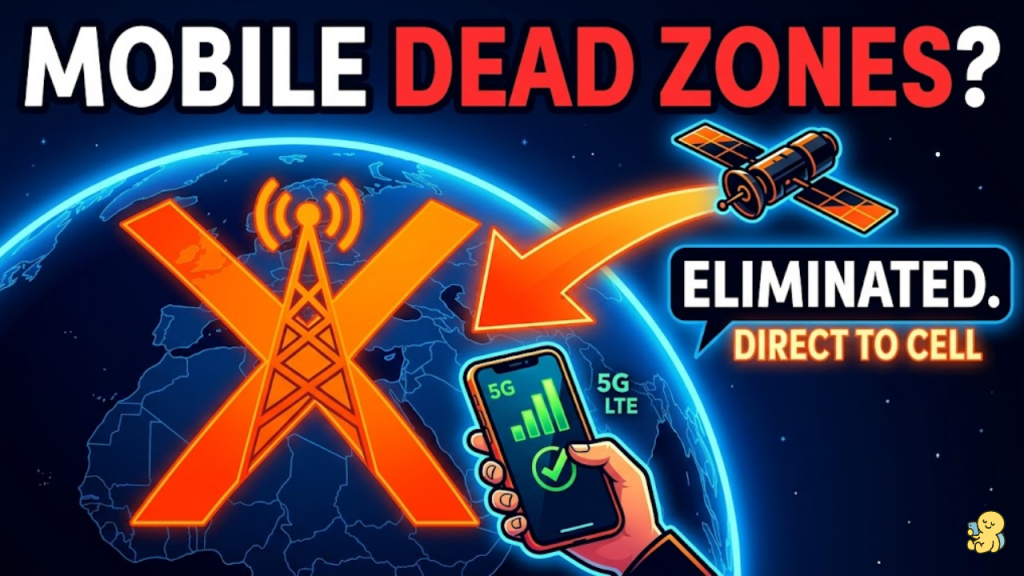
Direct-to-Cell (D2C) is a breakthrough that allows your standard smartphone to connect directly to satellites in orbit, just like it connects to a terrestrial cell tower. In 2026, this technology has moved from experimental trials to commercial reality. Instead of relying on ground-based infrastructure, your phone communicates with a constellation of Low-Earth Orbit (LEO) satellites. Consequently, you get connectivity in remote mountains, deserts, and even the middle of the ocean, provided you have a clear view of the sky.
This innovation does not require special hardware. Your current smartphone already possesses the radio equipment needed to talk to these satellites, provided the network operator has partnered with a satellite provider.
How It Works: The “Cell Tower in the Sky”
Think of a satellite as a mobile base station that simply happens to be 500 kilometers above you. Here is the technical breakdown of how this connection is made:
- Low-Earth Orbit (LEO): Unlike older, high-orbit satellites that are 35,000 kilometers away, LEO satellites orbit close to Earth. This proximity keeps latency low enough for SMS, voice, and basic data.
- Phased Array Antennas: Satellites carry massive, highly sensitive antennas. These antennas “listen” for the faint whisper of a smartphone signal from space. Essentially, the satellite acts like a giant ear that can pick up the low-power signal your phone broadcasts.
- 3GPP Standards: The magic relies on the 3GPP Release 17 and 18 standards. These standards define a common “language” that both your phone and the satellite speak, allowing your device to “hand over” its connection from a ground tower to a satellite without you needing to do anything.
Traditional Cell Towers vs. Direct-to-Cell
| Feature | Traditional Cell Tower | Direct-to-Cell Satellite |
| Coverage Area | Limited (miles) | Global (anywhere with sky view) |
| Infrastructure | Fiber + Physical Towers | Space-based constellations |
| Best For | High-speed data, cities | Emergencies, SMS, low-speed data |
| Latency | Very Low (<20ms) | Moderate to High (50ms+) |
| Dependency | Requires ground power/backhaul | Requires clear line-of-sight |
The Limitations: Why It Is Not Magic
While D2C is a game-changer, it is not a direct replacement for your fiber internet or 5G urban network. You should manage your expectations for 2026 performance.
- Line of Sight is Mandatory: Satellites cannot “punch” through mountains, dense forests, or building roofs. If you are indoors or in a canyon, the signal will likely drop. You need an open sky.
- Bandwidth Constraints: Current LEO constellations share bandwidth across huge geographic areas. Therefore, you should not expect to stream 4K video. Instead, this tech is optimized for “lifeline” connectivity—SOS messaging, location sharing, and basic web updates.
- Spectrum Conflicts: Satellite operators must fight for the same radio frequencies used by terrestrial carriers. Regulatory bodies are still working to prevent interference, which can lead to regional service gaps.
Frequently Asked Questions (FAQ)
1. Do I need a new phone for Direct-to-Cell?
In most cases, no. If your phone supports the required LTE bands and your carrier offers the service, it should work. However, always check your provider’s “compatible device list” to be sure.
2. Is this service free?
Most carriers treat it as a “Bolt-On” feature. For example, some offer it as a premium add-on for a few pounds or dollars per month, while others include it in high-tier plans.
3. Can I use this to browse the web?
Currently, it is mostly for SMS, location sharing, and emergency apps. While data speeds are improving in 2026, it is not yet suitable for heavy tasks like streaming or gaming.
4. Why do I see an Apple Security Warning on my satellite setup?
If your satellite-linked app attempts to use location services or personal data without explicit permissions or secure connections, you may trigger an Apple Security Warning on your iPhone.
5. Will it work in my house?
Generally, no. The signal is too weak to penetrate walls, roofs, or even heavy tree cover. You must be outdoors with a view of the sky.
6. Who are the main players in 2026?
Starlink (SpaceX), AST SpaceMobile, and partnerships between carriers like Deutsche Telekom and O2 are leading the charge globally.
7. Does this replace 5G?
No, it complements 5G. It is an “extension” that fills the gaps where building towers is too expensive or impossible.
8. What happens during a storm?
Heavy rain or thick cloud cover can cause “rain fade,” which degrades the signal. However, LEO satellites are closer to Earth than traditional ones, making them more resilient than the old satellite TV setups.
Final Verdict: Connectivity Everywhere
In 2026, Direct-to-Cell satellite technology has effectively ended the era of the “total dead zone.” While it is not yet a replacement for your high-speed home internet, it is the ultimate safety net for explorers, travelers, and remote workers who need to stay connected.
Ready to upgrade your mobile gear? Explore our guide on The Rise of Neumorphism in 2026 Dashboard Design to see how to build better interfaces, or learn how to secure your devices in Why Passkeys are Replacing Traditional Passwords.
Authority Resources
- TrendForce: The Growth of Direct-to-Device Connectivity – Analysis on market growth and infrastructure shifts.
- Counterpoint Research: MWC 2026 Connectivity Updates – Detailed reports on carrier partnerships and chipset alignment.
- Militarnyi: The Technical Reality of Starlink D2C – An excellent deep dive into the engineering of orbital base stations.
- O2 Satellite Connectivity Guide – A practical example of how D2C is being offered to retail consumers.