What are autonomous satellite fleets in 2026?
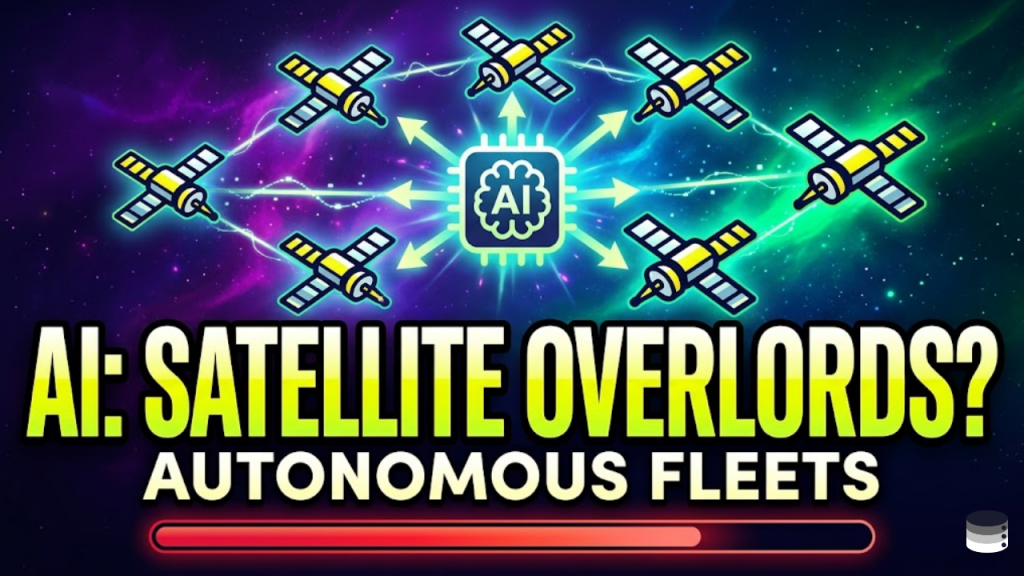
Autonomous satellite fleets are networked constellations of spacecraft that use onboard artificial intelligence to make real-time decisions without waiting for ground-station commands. In 2026, satellites have evolved from “Level 3” (scripted from Earth) to “Level 4 and 5” (autonomous learning) systems. These “thinking” satellites use Edge AI and Multi-Agent Systems to coordinate maneuvers, process data in orbit, and maintain unbreakable connectivity across global networks.
4 Core Pillars of Orbital AI (2026)
The transition to autonomous fleets is driven by the need to handle massive volumes of data and congested orbital paths.
1. Edge AI and Onboard Processing
In 2026, satellites no longer “dump” raw data to Earth. Instead, they use onboard AI to filter and analyze imagery immediately.
- Actionable Intelligence: AI identifies specific events, like a missile launch, a gas leak, or a ship’s heading, and only downlinks the “actionable” results, slashing latency and cost.
- Data Compression: AI models selectively compress data by up to 100x without losing critical information, ensuring essential insights arrive first.
2. Autonomous Collision Avoidance
With thousands of new satellites launched in early 2026, the risk of “Kessler Syndrome” (cascading collisions) is a primary concern.
- Real-Time SSA: AI systems continuously monitor Space Situational Awareness (SSA) data to track debris as small as 1 cm.
- Dynamic Planning: Satellites use AI to plan and execute evasive maneuvers in seconds, coordinating with neighboring spacecraft to ensure one move doesn’t cause a secondary collision.
3. Software-Defined Network Orchestration
Modern constellations are “software-defined platforms” that dynamically shift capacity.
- Cognitive Networks: AI manages Inter-Satellite Links (ISLs) to re-route bandwidth in real-time, surging power to disaster zones or busy shipping lanes in milliseconds.
- Hybrid Handoffs: AI automates the “handover” between different orbits (GEO to LEO) and terrestrial 5G/6G towers to guarantee 100% connectivity.
4. Distributed Federated Learning
To improve without sharing sensitive raw data, fleets now use Federated Learning.
- Personalized Updates: Multiple satellites jointly train AI models on orbit. They share “mathematical updates” rather than actual images, allowing the entire fleet to learn from one satellite’s unique observations.
The Impact: Reactive vs. Proactive Management
The shift to AI management allows satellite operators to move from “reacting to yesterday” to “preventing today’s risks”.
| Feature | Legacy Ground-Based Management | Autonomous Fleet AI (2026) |
| Decision Latency | Minutes to Hours (Round-trip) | Milliseconds (Local) |
| Data Handling | Downlink everything (Expensive) | Downlink insights only |
| Scaling | Manual/Scripted (Hard to scale) | Self-Organizing (Fleet-wide) |
| Resilience | Single point of failure (Ground) | Distributed/Fault-Tolerant |
| Sustainability | High debris risk | Automated debris mitigation |
Frequently Asked Questions (FAQ)
1. Does AI make satellites more vulnerable to cyberattacks?
While it introduces new vectors, AI also powers Satellite Cybersecurity. In 2026, fleets use Zero-Trust Architectures (ZTA) and AI-driven intrusion detection to identify and block anti-satellite threats in real-time.
2. Is “Space Edge Computing” the same as Earth’s?
Conceptually, yes. However, Space Edge AI must survive radiation-induced faults and operate within strict Power, Weight, and Cost (SWaP-C) limits that don’t exist on Earth.
3. What happens if a satellite’s AI “hallucinates”?
To prevent errors, autonomous fleets use Multimodal Foundation Models that cross-reference different data types (e.g., radar vs. optical) to confirm an event before taking action.
4. Why do I see an Apple Security Warning on my satellite control app?
If your mobile control dashboard uses unverified inter-satellite link protocols or lacks Post-Quantum Cryptography for its command-and-control channel, you may trigger an Apple Security Warning on your iPhone.
5. Can AI help with space debris removal?
Yes. In 2026, AI is used for Active Debris Removal (ADR) missions, helping robotic “cleanup” satellites physically capture or laser-ablate debris surfaces to clear busy orbital lanes.
Final Verdict: The Sky is Thinking
In 2026, the role of AI is no longer just “reporting”; it is autonomous action. By turning satellite constellations into real-time decision-making platforms, AI ensures that the infrastructure of the future is as flexible, resilient, and intelligent as the cloud computing networks we use on Earth.
Ready to explore the orbital edge? Check out our guide on WebGL and Three.js for 3D Product Showcases to see how space data is visualized, or learn about the Zero-Trust Architecture for Web Developers to secure your ground-station links.
Authority Resources
- Apogee Magazine: The Promise of Smart Satellites – Insights into Level 4 and 5 orbital autonomy.
- ET Edge: 7 Top Satcom Trends to Watch in 2026 – The emergence of cognitive networks and hybrid connectivity.
- arXiv: On-Orbit Space AI Survey (April 2026) – Deep technical dive into federated and multi-agent algorithms for constellations.
- StartUs Insights: Top 10 Satellite Industry Trends [2026] – Mapping the shift toward sustainable and in-orbit services.