
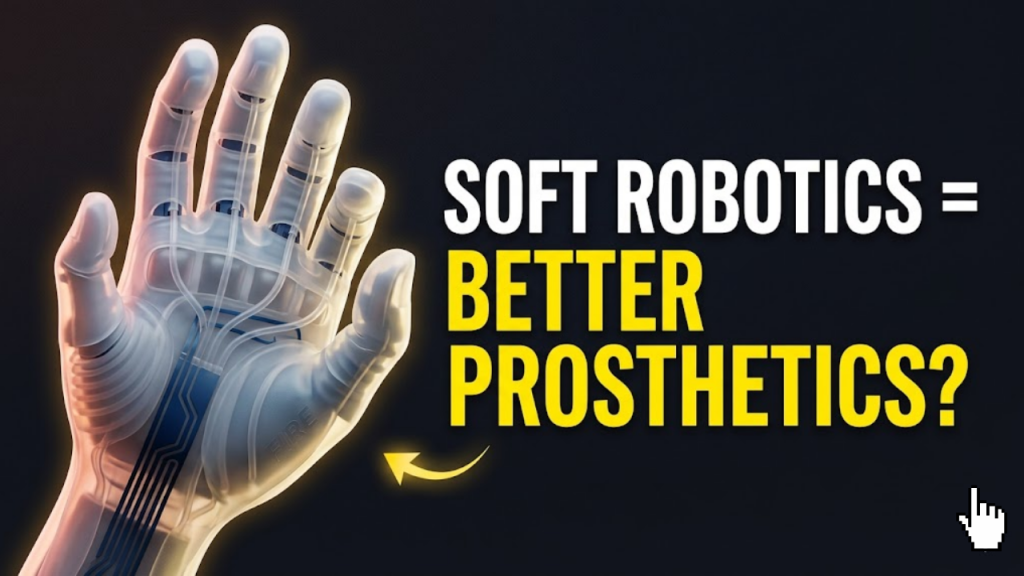
What is soft robotics in 2026?
Soft robotics is a field of engineering that focuses on using flexible, elastomeric materials (like silicone and hydrogels) rather than rigid metals or hard plastics. In 2026, this technology has become the secret to building prosthetic limbs that actually feel like human body parts. While traditional prosthetics are often stiff and mechanical, soft robotic limbs use flexible actuators to mimic the natural movement of muscles and tendons. Consequently, they offer a safer, more comfortable, and highly adaptive interface for the human body.
By prioritizing compliance and flexibility, soft robotics ensures that artificial limbs do not just “perform” tasks but “respond” to the environment in real time.
The 3 Pillars of Soft Prosthetic Design
In 2026, the success of soft robotics in prosthetics is built on three core mechanical principles.
1. Biomimetic Compliance
Traditional robots are “stiff.” If you run into a rigid robotic arm, it can hurt you. Soft robots, however, are naturally “compliant.”
- The Benefit: Because they are made of squishy, flexible materials, they can deform upon contact. This means they are inherently safe for daily interactions. If a soft robotic hand bumps into a child or a pet, it absorbs the energy instead of delivering a rigid impact.
2. Muscle-Like Actuation
Soft limbs use “artificial muscles” rather than heavy motors. In 2026, the most popular methods are pneumatic networks (PneuNets) and Shape Memory Alloys (SMA).
- The Benefit: These actuators generate movement by inflating or heating, which feels much more like the subtle contraction of a biological muscle. This results in fluid, natural-looking gestures that are nearly silent.
3. Adaptive Sensing
Soft robots in 2026 are “smart.” Because the materials themselves are flexible, engineers embed tiny strain and pressure sensors directly into the skin of the limb.
- The Benefit: The limb can “feel” the shape of the object it is grabbing. This enables the prosthetic to adjust its grip force automatically. If the limb senses a fragile egg, it applies light pressure; if it senses a heavy bottle, it tightens its hold.
Technical Breakthroughs in 2026 Materials
The 2026 landscape is defined by “Material Intelligence.” We are no longer just building with rubber; we are building with programmable matter.
- Wasm-Driven Control: Because soft robotic responses are so complex, developers now use WebAssembly (Wasm) on the edge to process sensor data locally in the device. This ensures the limb responds in under 50ms, preventing the “lag” that makes robotic limbs feel synthetic.
- Self-Healing Polymers: Advanced 2026 prosthetics are testing “self-healing” skins. These materials can repair minor punctures or scuffs on their own, drastically increasing the lifespan of the device and lowering maintenance costs for patients.
- Integrated Micro-Pumps: A major hurdle for pneumatic (air-based) prosthetics used to be the bulky external pump. In 2026, manufacturers are integrating miniaturized, silent micro-pumps directly into the socket, making the device completely untethered and mobile.
Frequently Asked Questions (FAQ)
1. How is this different from “Bionic” limbs?
Bionic limbs usually refer to rigid robotics that use motors and gears. Soft robotics is a subset that prioritizes safety and flexibility using flexible polymers. Often, the best 2026 devices are “hybrids” that use a rigid core for strength and soft actuators for movement.
2. Can soft robots lift heavy objects?
Modern soft actuators, specifically pneumatic artificial muscles, can achieve force outputs exceeding 1,500 N/kg. This makes them surprisingly strong, capable of handling daily heavy lifting while remaining soft to the touch.
3. Why do I see an Apple Security Warning on my robotic limb interface?
If your prosthetic limb’s mobile companion app attempts to access hardware-level sensors without proper permission or uses unverified wireless protocols, you may trigger an Apple Security Warning on your iPhone.
4. Are these prosthetics expensive?
They were initially. However, 2026 has seen a massive price drop due to 3D-printed custom sockets and modular soft-actuator parts. Custom fitting is now faster and cheaper than ever.
5. Do soft robots require batteries?
Yes. Because they use sensors and small pumps or actuators, they require power. However, 2026 battery technology (solid-state) has significantly improved, allowing for all-day wear on a single charge.
6. Is it painful to wear?
No, it is the opposite. Soft robotics excel at interface comfort. Because the materials match the “softness” of human tissue, they prevent the skin irritation and sores common with rigid, hard-plastic sockets.
7. What is “Biomimetic” design?
Biomimetic design means mimicking nature. A biomimetic prosthetic doesn’t just do the job; it does it in the same way a human limb does—using tendons, layers of tissue, and adaptive friction.
8. How long do they last?
With the rise of durable polymers and self-healing skins, a modern soft robotic prosthetic is designed to last 3 to 5 years of heavy daily use, provided the electronics are maintained.
Final Verdict: The Future is Soft
In 2026, Soft Robotics is turning prosthetics from “medical tools” into “human extensions.” By focusing on compliance, safety, and natural sensation, we are not just helping people move; we are helping them regain a sense of self.
Ready to explore the future of human-machine integration? Learn about the computing power behind these limbs in our guide on The Impact of WebAssembly (Wasm) on Browser Performance or see how to design accessible user interfaces in Accessibility First: Building WCAG 2.2 Compliant Forms.
Authority Resources
- PatSnap: Soft Robotics Actuator 2026 Landscape – Analysis of pneumatic vs SMA vs DEA paradigms.
- MDNPI: Hand Prosthesis with Soft Robotics Technology – A deep dive into myoelectric control and neural network integration.
- PMC/NIH: Wearable and Implantable Soft Robots – The foundational science of elastomer materials in health tech.
- ThinkRobotics: Robotic Prosthetics Revolution – The socio-economic impact of adaptive, AI-driven limbs.